IAMA Art Museum in San Francisco


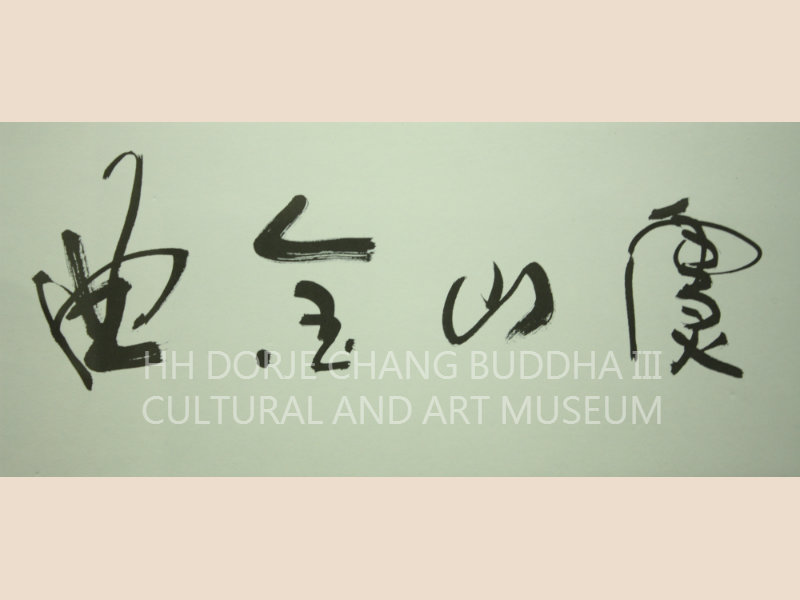
GOLDEN TUNE FROM VULTURE PEAK靈山金曲
From ancient times to the present, no product of an art or field of study has been able to reflect a person’s moral character and knowledge---except for calligraphy. The aura created by a person’s achievements or creations in a certain form of art or field of study often covers up his shortcomings in knowledge and character. However, calligraphy is an exception to this rule. Calligraphy is like a three-dimensional projecting mirror. The depth of one’s knowledge, the level of one’s moral character, and the strength of one’s mind are revealed through each stroke of the brush. There is no way to conceal such things. When looking at the quality of a person’s ordinary writing of Chinese characters, most people can discern the level of that person’s education. This is all the more true with respect to looking at a person’s calligraphy.
One cannot find in any history book an unknowledgeable person who has made a contribution to calligraphy. Those with profound and extensive knowledge are not necessarily proficient in calligraphy. However, a great calligrapher must have both knowledge and good brushwork. Without exception, all of the famous calligraphers throughout the generations were great masters of literature who had profound knowledge. Examples of this include ancient calligraphers such as Xizhi Wang, Su Huai, Shaoji He, Huaiguan Zhang, and Fei Yue. A modern example is Youren Yu. Each one of them was an extremely learned literary giant and paragon of virtue.
Knowledge is the pillar and cornerstone of calligraphy. Moral character can be seen in the style and charm of calligraphy. Thus, calligraphy requires both knowledge and moral character.
The calligraphy of H.H. Dorje Chang Buddha III is not bound by worldly conventions and is devoid of unnecessary flamboyance. It is highly refined and based upon ingenious artistic conception. His Holiness’s strokes are sometimes written in a swift curling style. However, in an instant, His Holiness can express the innocent and natural charm of a child. There is wonder in even common strokes. His calligraphy is naturally graceful, exhibiting depth and brilliance. The calligraphy of His Holiness contains an invisible force that makes the characters seem much grander than they appear on a superficial level. His strokes look harmoniously smooth and unbroken. The Chinese characters may appear strong and vigorous, like a soaring dragon or mighty tiger. They may appear clear and gently elegant, like slowly floating clouds, cranes flying among pine trees, or dancing swans. They may appear simple and unadorned, like the free heart of a child. They are gracefully understated and completely devoid of any mundane quality. The calligraphy of H.H. Dorje Chang Buddha III is natural in quality and resonates with the true nature of the universe. A deep power underlies His Holiness’s strokes.
The ability of H.H. Dorje Chang Buddha III to reach such great heights in calligraphy is completely due to His Holiness’s vast knowledge and profound talents. Of course, His Holiness is extremely adept at learning from the styles of others since this is a simple matter for a Buddha. For example, even in the initial stage of learning calligraphy, H.H. Dorje Chang Buddha III had solid skills in the traditional cursive style of writing and also had extensive learning. We can see from the first calligraphic work in this book the adroitness His Holiness had when He was first learning this cursive script.
留言
張貼留言